ADSL, the subject level data set
ADSL has one record per subject. Every other ADaM data set takes its treatment, population flags and key dates from ADSL, so an error here repeats everywhere. In this chapter you build the core of ADSL by hand from SDTM. Then you prove that it is the same as the reference ADSL of the pilot study. Last, you write your first study macro: a small tool for the one thing the program does three times.
9.0 Before you start: what SDTM looks like
Section titled “9.0 Before you start: what SDTM looks like”ADaM is built from SDTM (the Study Data Tabulation Model), the standard form of the collected data. Each SDTM data set is a domain, and each domain has one record per something. Know what one record means before you count anything.
| Domain | Records | One record per |
|---|---|---|
| DM (demographics) | 306 | subject, screen failures included (52 of them) |
| EX (exposure) | 591 | dosing interval |
| AE (adverse events) | 1191 | adverse event, for 225 subjects |
| VS (vital signs) | 29643 | measurement |
| SUPPDM | 1197 | extra value (qualifier) of a DM record |
Four kinds of variables come back in many domains. Their first two letters are the domain, so AESEQ is the sequence number of AE and VSDTC is the date of VS:
--SEQnumbers the records of a subject: subject 01-701-1015 has AE records withAESEQ1, 2 and 3. Together withUSUBJID, it is the key of a record. ADaM keeps it, so every analysis value can be traced back to its source record.--DTCis a date as text, in ISO 8601 form (2014-01-03). Text can hold a partial date, such as2013-03, which a SAS date cannot. Chapter 11 shows what to do with partial dates.--DYis the study day: the number of days from the first dose. There is no day 0. The weight of subject 01-701-1015 hasVSDY-7 at screening, 1 at baseline, 15 at week 2 and 29 at week 4.--TESTCDnames what was measured, in the findings domains such as VS and LB (WEIGHT,SYSBP). One data set holds many tests.
SUPPDM holds the values that have no standard variable in DM. It is a tall data set: one record per subject and value, with the name of the value in QNAM and the value in QVAL. Subject 01-701-1015 has six records: COMPLT8, COMPLT16, COMPLT24, EFFICACY, ITT and SAFETY, each with QVAL = "Y". The pilot stores only the Y values: SAFETY and ITT have 254 records each, EFFICACY 234 and COMPLT24 118. A missing record means “no”.
ADSL needs these values as columns, one record per subject. So step 040 of the program turns the rows into columns with PROC TRANSPOSE (ID qnam; VAR qval;) and then sets the flag to N when a subject has no record. Chapter 7 explains PROC TRANSPOSE.
9.1 The plan: one numbered step per idea
Section titled “9.1 The plan: one numbered step per idea”Write ADSL as a chain of small steps. Each step reads the data set of the step before and adds one idea. The numbers have gaps (010, 020, 030) so that you can insert a step later without renaming the others. A QC programmer, or you in six months, can double-click any step in the Libraries tab and see what it added.
| Step | Adds | Source |
|---|---|---|
| 010 | one record per randomised subject | DM |
| 020 | TRT01P, TRT01PN, TRT01A, TRT01AN: planned and actual treatment of period 01, text and number | DM ARM |
| 030 | TRTSDT, TRTEDT: date of the first and the last dose | EX |
| 040 | population flags, Y or N: SAFFL (safety), ITTFL (intent-to-treat), EFFFL (efficacy), COMP24FL (completed week 24) | SUPPDM |
| 050 | AGEGR1 (age group), HEIGHTBL, WEIGHTBL and BMIBL (height, weight and BMI at baseline) | DM, VS |
9.2 The program
Section titled “9.2 The program”/* Chapter 9: ADSL by hand, one numbered step per idea */
/* Step 010: one record per randomised subject */DATA adsl_010; SET sdtm.dm(KEEP=studyid usubjid subjid siteid arm armcd age ageu sex race ethnic rfstdtc rfendtc); WHERE armcd NE "Scrnfail";RUN;
/* Step 020: planned and actual treatment, text and number */DATA adsl_020; LENGTH trt01p trt01a $20; SET adsl_010; trt01p = arm; IF arm = "Placebo" THEN trt01pn = 0; ELSE IF arm = "Xanomeline Low Dose" THEN trt01pn = 54; ELSE IF arm = "Xanomeline High Dose" THEN trt01pn = 81; trt01a = trt01p; trt01an = trt01pn;RUN;
/* Step 030: first and last dose date from EX */DATA ex_dt; SET sdtm.ex(KEEP=usubjid exstdtc exendtc); exstdt = INPUT(exstdtc, ?? E8601DA.); exendt = INPUT(exendtc, ?? E8601DA.);RUN;
/* An EX record without an end date means: still dosed when the subject left */PROC SQL; CREATE TABLE ex_first_last AS SELECT usubjid, MIN(exstdt) AS trtsdt FORMAT=DATE9., MAX(exendt) AS exlast FORMAT=DATE9., SUM(MISSING(exendt)) AS n_open FROM ex_dt GROUP BY usubjid;QUIT;
PROC SORT DATA=adsl_020; BY usubjid; RUN;
DATA adsl_030; MERGE adsl_020(IN=indm) ex_first_last; BY usubjid; IF indm; /* open last dose record: treatment ends at the end of the study */ IF n_open > 0 THEN trtedt = INPUT(rfendtc, ?? E8601DA.); ELSE trtedt = exlast; FORMAT trtedt DATE9.; DROP exlast n_open;RUN;
/* Step 040: population flags from SUPPDM, N when no record */PROC TRANSPOSE DATA=sdtm.suppdm OUT=supp(DROP=_name_ _label_); BY usubjid; ID qnam; VAR qval;RUN;
DATA adsl_040; LENGTH saffl ittfl efffl comp24fl $1; MERGE adsl_030(IN=inadsl) supp(KEEP=usubjid safety itt efficacy complt24); BY usubjid; IF inadsl; IF safety = "Y" THEN saffl = "Y"; ELSE saffl = "N"; IF itt = "Y" THEN ittfl = "Y"; ELSE ittfl = "N"; IF efficacy = "Y" THEN efffl = "Y"; ELSE efffl = "N"; IF complt24 = "Y" THEN comp24fl = "Y"; ELSE comp24fl = "N"; DROP safety itt efficacy complt24;RUN;
/* Step 050: age group and baseline BMI *//* Weight has a baseline flag; height is measured once, at screening */PROC SQL; CREATE TABLE vsbl_w AS SELECT usubjid, MAX(CASE WHEN vstestcd = "WEIGHT" AND vsblfl = "Y" THEN vsstresn END) AS weightbl, MAX(CASE WHEN vstestcd = "HEIGHT" THEN vsstresn END) AS heightbl FROM sdtm.vs WHERE vstestcd IN ("WEIGHT" "HEIGHT") GROUP BY usubjid;QUIT;
DATA adsl; ATTRIB trt01p LENGTH=$20 LABEL="Planned Treatment for Period 01" trt01pn LABEL="Planned Treatment for Period 01 (N)" trt01a LENGTH=$20 LABEL="Actual Treatment for Period 01" trtsdt LABEL="Date of First Exposure to Treatment" FORMAT=DATE9. trtedt LABEL="Date of Last Exposure to Treatment" FORMAT=DATE9. agegr1 LENGTH=$5 LABEL="Pooled Age Group 1" saffl LENGTH=$1 LABEL="Safety Population Flag" ittfl LENGTH=$1 LABEL="Intent-To-Treat Population Flag" efffl LENGTH=$1 LABEL="Efficacy Population Flag" comp24fl LENGTH=$1 LABEL="Completers of Week 24 Population Flag" heightbl LABEL="Baseline Height (cm)" weightbl LABEL="Baseline Weight (kg)" bmibl LABEL="Baseline BMI (kg/m^2)"; MERGE adsl_040(IN=inadsl) vsbl_w; BY usubjid; IF inadsl; IF age < 65 THEN agegr1 = "<65"; ELSE IF age > 80 THEN agegr1 = ">80"; ELSE agegr1 = "65-80"; /* the specification keeps one decimal */ IF NOT MISSING(weightbl) THEN weightbl = ROUND(weightbl, 0.1); IF NOT MISSING(heightbl) THEN heightbl = ROUND(heightbl, 0.1); IF NOT MISSING(weightbl) AND NOT MISSING(heightbl) THEN bmibl = ROUND(weightbl / (heightbl / 100)**2, 0.1);RUN;
/* Compare with the reference ADSL */PROC COMPARE BASE=refadm.adsl COMPARE=adsl (KEEP=usubjid trt01p trt01pn trt01a trtsdt trtedt saffl ittfl efffl comp24fl agegr1 heightbl weightbl bmibl) CRITERION=1E-8 NOSUMMARY; ID usubjid; VAR trt01p trt01pn trt01a trtsdt trtedt saffl ittfl efffl comp24fl agegr1 heightbl weightbl bmibl;RUN;%PUT NOTE: PROC COMPARE result SYSINFO=&SYSINFO. (0 means equal);What you should see: every step has 254 observations, from WORK.ADSL_010 to WORK.ADSL, and the log says:
NOTE: PROC COMPARE result SYSINFO=0 (0 means equal)SYSINFO=0 means that PROC COMPARE found no difference. It compared 13 variables for all 254 subjects: TRT01P, TRT01PN, TRT01A, TRTSDT, TRTEDT, SAFFL, ITTFL, EFFFL, COMP24FL, AGEGR1, HEIGHTBL, WEIGHTBL and BMIBL. Your ADSL and the reference ADSL agree.
Chapters 2 and 7 used PROC COMPARE without an explanation. Here are its parts:
BASE=is the data set you trust (the reference),COMPARE=is yours.ID usubjid;pairs the records by subject, not by row number. Both data sets must be sorted by theIDvariables.VARlists the variables to compare. Without it, PROC COMPARE compares every variable with the same name.CRITERION=1E-8treats numbers that differ by less than 0.00000001 as equal, so rounding noise is not a difference.NOSUMMARYleaves out the summary pages, so the output shows only the differences.- After the step,
&SYSINFO.holds the result as a sum of codes. 0 means equal. 32 means a variable has a different label. 64 means a record ofBASE=has no partner. 128 means a record ofCOMPARE=has no partner. 4096 means at least one value differs. So 4224 (4096 + 128) means both.
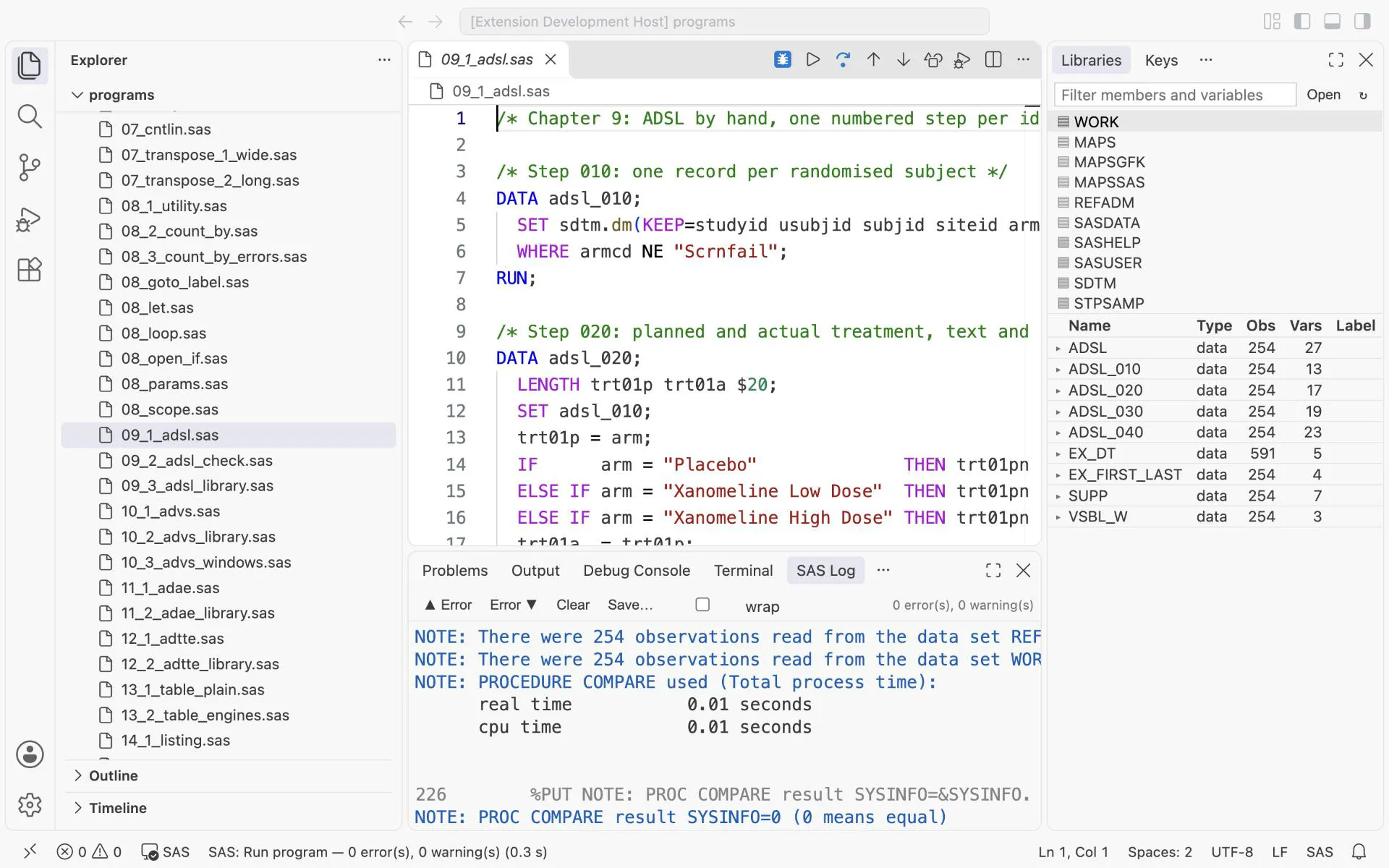
After F4 on 09_1_adsl.sas: the Libraries tab lists every numbered step, ADSL_010 to ADSL_040 and the final ADSL, each with 254 rows. The log ends with PROC COMPARE result SYSINFO=0: equal to the CDISC reference.
Exercise 9-1. Add TRTDURD, the duration of treatment in days: trtedt - trtsdt + 1. Compare it with TRTDUR in the reference ADSL.
9.3 Three lessons from the first runs
Section titled “9.3 Three lessons from the first runs”The program above is the fourth version. The first three did not match the reference, and each difference taught a rule that every ADSL needs.
Height has no baseline flag
Section titled “Height has no baseline flag”The first version took height and weight from the records with VSBLFL = "Y". The log said ERROR: Variable height is not on file WORK.VSBL_W. In the pilot, height is measured once, at screening. That record has no baseline flag. Read each parameter from the record the specification names, not from one rule for all.
The specification rounds
Section titled “The specification rounds”The second version found differences of a few hundredths in every height and weight: 147.32 against 147.3. The reference keeps one decimal.
When PROC COMPARE shows many small differences in one direction, look for a rounding rule before you look for a logic error. Round only when a value exists: ROUND of a missing value writes a NOTE that a log check flags.
An open dose record
Section titled “An open dose record”The third version found 6 subjects with a different TRTEDT. Look at the data before you change a rule:
/* Chapter 9: look at the data before you change a rule */PROC SQL; SELECT usubjid, exseq, extrt, exstdtc, exendtc FROM sdtm.ex WHERE usubjid IN ("01-704-1233" "01-705-1018");QUIT;What you should see:
| USUBJID | EXSEQ | EXTRT | EXSTDTC | EXENDTC |
|---|---|---|---|---|
| 01-704-1233 | 1 | PLACEBO | 2013-03-21 | 2013-04-04 |
| 01-704-1233 | 2 | PLACEBO | 2013-04-05 | |
| 01-705-1018 | 1 | PLACEBO | 2013-07-05 |
An EX record without an end date is an open dose record. It means that the subject was still taking the study drug when the subject left the study. MAX(exendt) ignores the missing value. It returns the end of an earlier record (04APR2013), or nothing at all. The reference ADSL uses the end of study date, RFENDTC from DM, instead: 14JUL2013 for subject 01-704-1233.
This is the book’s rule for TRTEDT, and step 030 does it:
TRTEDTis the latest EX end date of the subject.- When the subject has an open dose record,
TRTEDTisRFENDTC, the end of the study.
The rule changes 6 subjects of the pilot: 01-704-1233, 01-705-1018, 01-705-1031, 01-705-1303, 01-705-1377 and 01-705-1382. With it, PROC COMPARE gives SYSINFO=0 against the reference. You meet these 6 subjects twice more, from two other sides. Chapter 15 finds them in QC, when a simpler rule is compared with the reference. Chapter 16 finds them with a check program before any derivation, and the statistician gives the same rule.
Exercise 9-2. Change step 030 back to trtedt = exlast; for every subject and run the comparison. Which subjects differ, and what does PROC COMPARE show for them?
9.4 See it in DataStep Studio
Section titled “9.4 See it in DataStep Studio”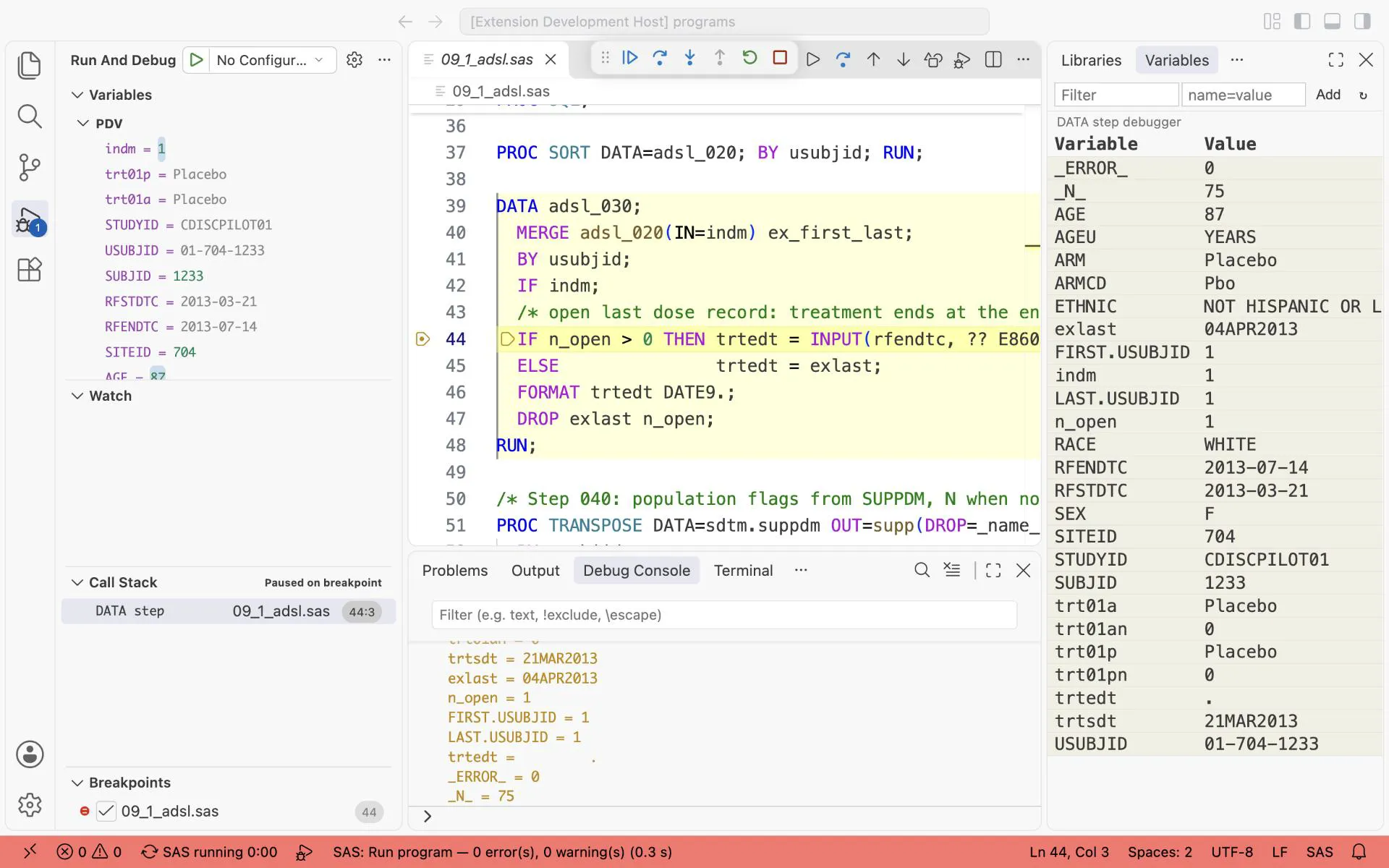
The DATA step debugger in ADSL_030, stopped for subject 01-704-1233 (condition usubjid = “01-704-1233”): n_open = 1, so the last dose record has no end date and TRTEDT comes from RFENDTC.
9.5 Write the tool when you repeat yourself
Section titled “9.5 Write the tool when you repeat yourself”Look at 09_1_adsl.sas again. Three times it turns an ISO 8601 text date into a SAS date: exstdtc, exendtc and rfendtc. Chapter 11 needs it again for adverse events, and there some dates have no day. When the same code comes back a third time, write it once as a macro and test the macro. This is a study macro: a small tool for this study, written by you, with a header that says what it does.
/* EXPECT: ERROR [M_ISO_DT] *//* Chapter 9: a study macro for ISO 8601 dates, written because 09_1 does the same thing three times (needs 09_1) */
/******************************************************************************* Macro : %m_iso_dt Version : 1.0 Purpose : Turn an ISO 8601 text date (--DTC) into a SAS date. With impute=FIRST or impute=LAST a date without a day (2013-03) gets the first or the last day of the month, and the flag variable says D (the day was imputed). A date with the year only stays missing. Parameters : data= input data set, data set options allowed (required) out= output data set (required) dtc= the ISO 8601 text variable, e.g. aestdtc (required) dt= the new SAS date variable, e.g. astdt (required) impute= NONE (default), FIRST or LAST flag= the new imputation flag variable, e.g. astdtf (required when impute is FIRST or LAST) Preconditions : &dtc. exists in &data. Postconditions : &out. = &data. plus &dt. (FORMAT DATE9.) and &flag. Change log : 2026-11-01 1.0 first version*******************************************************************************/%MACRO m_iso_dt(data=, out=, dtc=, dt=, impute=NONE, flag=); %LOCAL macro p ds dsid hasvar rc; %LET macro = M_ISO_DT; %LET impute = %UPCASE(&impute.);
/* Check the parameters: nothing runs when one check fails */ %DO p = 1 %TO 4; %LET ds = %SCAN(data out dtc dt, &p.); %IF %SUPERQ(&ds.) = %THEN %DO; %PUT %STR(ERR)OR: [¯o.] the parameter &ds.= is required.; %RETURN; %END; %END; /* the data set name without its options: sdtm.ex(KEEP=...) is sdtm.ex */ %LET ds = %SCAN(&data., 1, %STR(%()); %IF NOT %SYSFUNC(EXIST(&ds.)) %THEN %DO; %PUT %STR(ERR)OR: [¯o.] the data set &ds. does not exist.; %RETURN; %END; %LET dsid = %SYSFUNC(OPEN(&ds.)); %LET hasvar = %SYSFUNC(VARNUM(&dsid., &dtc.)); %LET rc = %SYSFUNC(CLOSE(&dsid.)); %IF &hasvar. = 0 %THEN %DO; %PUT %STR(ERR)OR: [¯o.] the variable &dtc. is not in &ds..; %RETURN; %END; %IF NOT (&impute. = NONE OR &impute. = FIRST OR &impute. = LAST) %THEN %DO; %PUT %STR(ERR)OR: [¯o.] impute=&impute. is not NONE, FIRST or LAST.; %RETURN; %END; %IF &impute. NE NONE AND %SUPERQ(flag) = %THEN %DO; %PUT %STR(ERR)OR: [¯o.] impute=&impute. needs flag=, the imputation flag variable.; %RETURN; %END;
/* The mechanism: the work variables have a private prefix, so they cannot */ /* overwrite a variable of the caller */ DATA &out.; SET &data.; %IF &impute. NE NONE %THEN %DO; LENGTH &flag. $1; &flag. = ""; %END; _mid_yy = INPUT(SUBSTR(&dtc., 1, 4), ?? 4.); _mid_mm = .; IF LENGTHN(&dtc.) >= 7 THEN _mid_mm = INPUT(SUBSTR(&dtc., 6, 2), ?? 2.); /* a complete date, perhaps with a time part: 2013-03-21T10:30 */ IF LENGTHN(&dtc.) >= 10 THEN &dt. = INPUT(SUBSTR(&dtc., 1, 10), ?? E8601DA.); %IF &impute. = FIRST %THEN %DO; ELSE IF NOT MISSING(_mid_mm) THEN DO; &dt. = MDY(_mid_mm, 1, _mid_yy); &flag. = "D"; END; %END; %ELSE %IF &impute. = LAST %THEN %DO; ELSE IF NOT MISSING(_mid_mm) THEN DO; &dt. = INTNX("MONTH", MDY(_mid_mm, 1, _mid_yy), 0, "END"); &flag. = "D"; END; %END; ELSE &dt. = .; FORMAT &dt. DATE9.; DROP _mid_yy _mid_mm; RUN;%MEND m_iso_dt;
/* Use it: the dose dates of 09_1 again, now with the macro */%m_iso_dt(data=sdtm.ex(KEEP=usubjid exstdtc exendtc), out=ex_m010, dtc=exstdtc, dt=exstdt)%m_iso_dt(data=ex_m010, out=ex_m020, dtc=exendtc, dt=exendt)
/* the same records in the same order as WORK.EX_DT of 09_1 */PROC COMPARE BASE=ex_dt COMPARE=ex_m020 NOSUMMARY; VAR exstdt exendt;RUN;%PUT NOTE: PROC COMPARE result SYSINFO=&SYSINFO. (0 means equal);
/* Test it on the cases the study data does not have yet */DATA iso_cases; LENGTH dtc $16; INPUT dtc $ exp_first :DATE9. exp_last :DATE9.; IF dtc = "-" THEN dtc = ""; FORMAT exp_first exp_last DATE9.; DATALINES;2013-03-21 21MAR2013 21MAR20132013-03-21T10:30 21MAR2013 21MAR20132013-03 01MAR2013 31MAR20132012-02 01FEB2012 29FEB20122013 . .- . .;RUN;
%m_iso_dt(data=iso_cases, out=iso_first, dtc=dtc, dt=dt, impute=FIRST, flag=dtf)%m_iso_dt(data=iso_cases, out=iso_last, dtc=dtc, dt=dt, impute=LAST, flag=dtf)
DATA iso_test; MERGE iso_first(RENAME=(dt=dt_first dtf=dtf_first)) iso_last(RENAME=(dt=dt_last dtf=dtf_last)); LENGTH result $4; IF dt_first = exp_first AND dt_last = exp_last THEN result = "pass"; ELSE result = "FAIL";RUN;
PROC PRINT DATA=iso_test NOOBS; VAR dtc dt_first dtf_first dt_last dtf_last result;RUN;
/* A wrong call stops before any step runs: here the name of the variable is wrong */%m_iso_dt(data=sdtm.ex, out=ex_bad, dtc=exstdt, dt=exstdt_n)Read the macro from the top:
-
The header says what the macro does, what it needs (preconditions) and what it gives (postconditions). A reader does not have to read the code to use it.
-
The parameter checks come first. Each check looks for one wrong call: a required parameter that is empty, an input that does not exist, a variable that is not there, or an
impute=value that is not allowed. A wrong call writesERROR: [M_ISO_DT] ...and stops before any step runs. Three tools are new here:%RETURNends the macro at once, like%GOTOto the%MEND.dsholds a name, such asdata.%SUPERQ(&ds.)then gives the value ofdata. It does not resolve&or%in that value. The loop puts the namesdata,out,dtcanddtindsone after the other, so one%IFchecks four parameters.%SYSFUNC(OPEN(...)),VARNUMandCLOSElook into a data set without a DATA step.OPENreturns a number for the open data set, or 0 if it cannot open it.VARNUMreturns the position of a variable, or 0 if the variable is not there.CLOSEreleases the data set. Always close what you open.
%SCAN(&data., 1, %STR(%())removes data set options, so thatsdtm.ex(KEEP=...)is checked assdtm.ex. -
The mechanism is one DATA step. The work variables have the prefix
_mid_, so they cannot overwrite a variable of the program that calls the macro.%IFwrites only the code the call needs: withimpute=NONEthere is no imputation code in the step at all. -
The test comes with the macro. First the program rebuilds the dose dates of
09_1_adsl.sasand compares them. Then it runs six cases. One is a complete date. Five are cases that the study data does not have yet: a time part, a missing day, a leap year, a year only and an empty date.
What you should see:
NOTE: PROC COMPARE result SYSINFO=0 (0 means equal)and the test table, every row pass:
| dtc | dt_first | dtf_first | dt_last | dtf_last | result |
|---|---|---|---|---|---|
| 2013-03-21 | 21MAR2013 | 21MAR2013 | pass | ||
| 2013-03-21T10:30 | 21MAR2013 | 21MAR2013 | pass | ||
| 2013-03 | 01MAR2013 | D | 31MAR2013 | D | pass |
| 2012-02 | 01FEB2012 | D | 29FEB2012 | D | pass |
| 2013 | . | . | pass | ||
| (empty) | . | . | pass |
The last call is wrong on purpose: dtc=exstdt names a variable that EX does not have. The log says
ERROR: [M_ISO_DT] the variable exstdt is not in sdtm.ex.and no step runs. A macro that stops with a clear message is easier to use than one that runs and gives a wrong date.
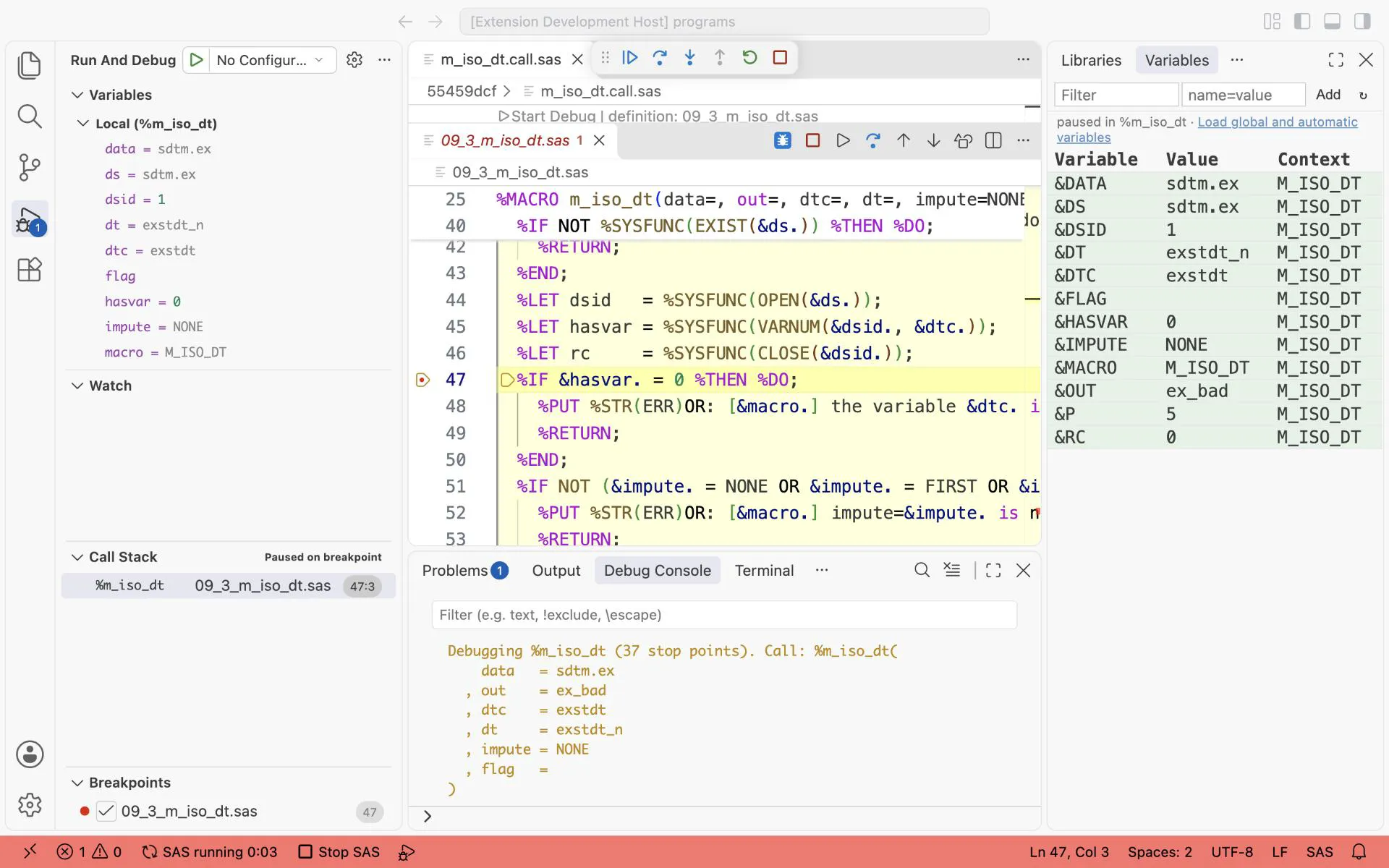
The macro debugger in the last call of %m_iso_dt, stopped at %IF &hasvar. = 0: dtc = exstdt, and hasvar = 0 because SDTM.EX has no variable EXSTDT. The next line writes the ERROR and stops the macro.
Exercise 9-3. Step 040 of 09_1_adsl.sas repeats one pattern four times: IF x = "Y" THEN flag = "Y"; ELSE flag = "N";. Write %m_yn(data=, out=, var=, flag=) and use it four times. Prove with PROC COMPARE that ADSL does not change.
Exercise 9-4. Add the case 2013-12 to iso_cases. What do impute=FIRST and impute=LAST give? Which SAS function finds the last day of a month for you?
Exercises
Section titled “Exercises”The exercises are next to the program they change: 9-1 and 9-2 change 09_1_adsl.sas, 9-3 and 9-4 change 09_3_m_iso_dt.sas. The answers are in Answers, Part II.